
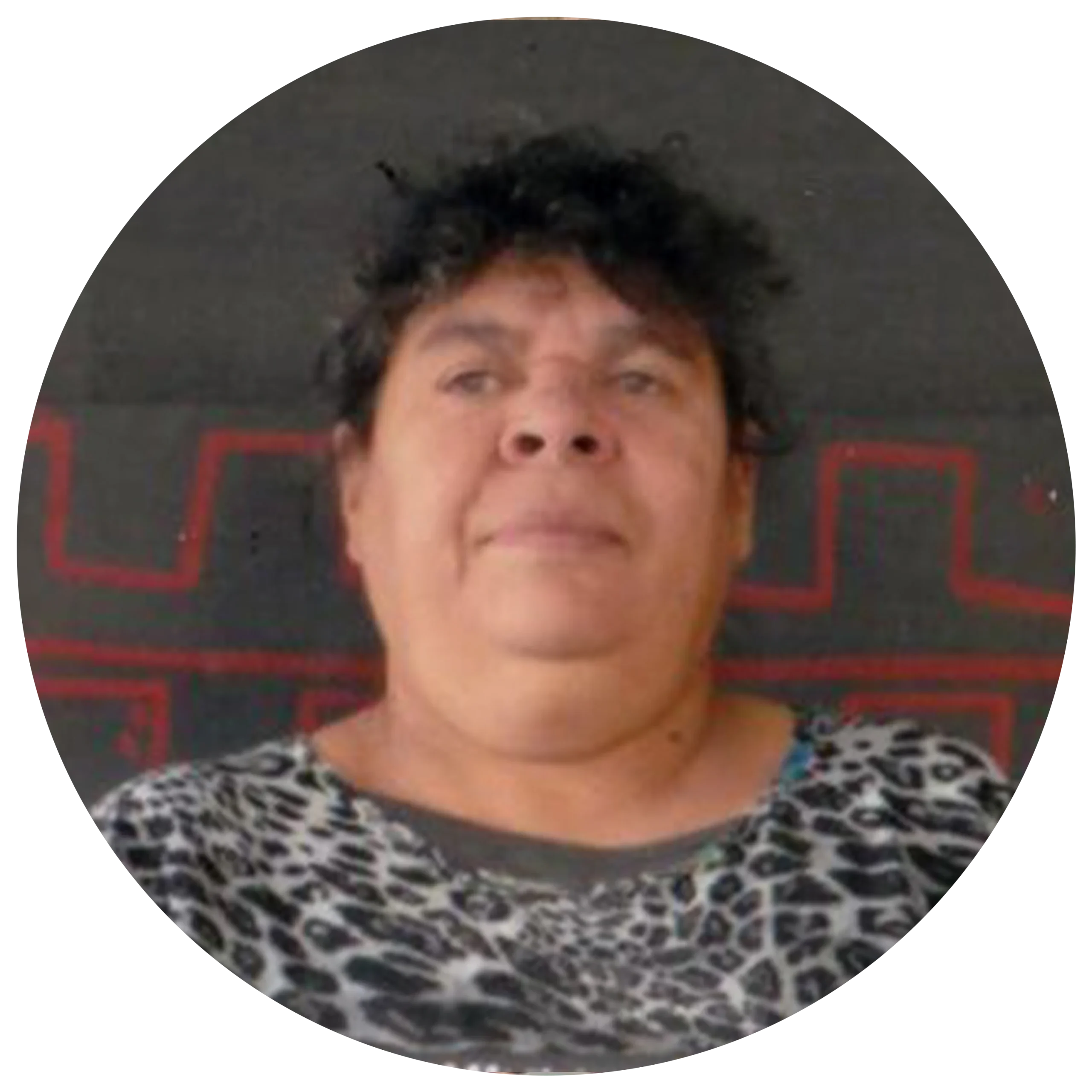
Jorna Newberry is a Pitjantjatjara artist born around 1959 in Angus Downs. She currently splits her time between Alice Springs, where her family lives, and Warakurna, choosing to live between modern culture and a more traditional one of her Indigenous heritage.
When Jorna is in her lands, she often goes bush with the women of the community for sacred ceremonies, passing on the knowledge of her heritage to her two daughters. When she goes camping, she hunts for kangaroos and goannas and collects bush tucker such as honey ants, witchetty grubs, and berries.
Her style is multilayered and abstract to maintain the secrecy of important cultural matters. She has worked closely with her uncle, Tommy Watson, and developed her own style.
“Tommy has had a big influence on me. He teaches me to be respectful in the way I paint,” she says, favouring a more abstract approach to her work rather than the symbolic approach of the Papunya Tula artists.
Jorna started painting in the mid-1990s at Warakurna. Her paintings refer to the country of Irrunytju in the Western desert and the significant places, traditionally places of spiritual knowledge and ancestral stories, that are bedded in the land.
Tommy Watson has described Irruntyju as ” my grandfather’s and grandmother’s country. When they were alive, they would take me around the country when I was a kid. That dreamtime country. That’s why we look after the country, go out whenever possible, and see if the rockholes are good.”
Tjukurpa (Wind Dreaming) is a story of her mother’s country at Utantja, a large stretch of sacred land where people go for ceremonial rites. “The wind ceremony forms winds, creates air to cool the lands,” she says, explaining that the cooler the land gets, the easier it is for hunting.
Newberry uses a vibrant and dramatic palette in her artworks; the canvases are alive with linear dotted flows describing movement, culture and history.
2023 The Perentie Nintaka, Gallery One, Southport QLD
2021 Jorna Newberry – Significant New Artworks by Jorna Newberry, Gallery One, Southport, QLD
2019 Jorna Newberry – Wind Dreaming, Cooee Art Gallery, Sydney
2024 Fire & Water, Japingka Gallery, Freemantle
2022 Ken Sisters & Jorna Newberry, Feature Paintings and Sculpture, Gallery One, Southport QLD
2021 Sounds of Summer 2, Japingka Gallery, Freemantle
2021 Sydney Contemporary 2021 | Not so virtual, Cooee Art Gallery, Sydney
2021 Aboriginal Art Exhibition – From the Desert to the Sea, Gallery One, Southport, QLD
2021 We Choose to Challenge, Coo-ee Fine Art Gallery, Sydney
2020 Summer Collection: Beautiful Works included in our Summer Collection, Brenda Colahan Fine Art, Sydney
2020 60 by 60 – Small Paintings, Japingka Gallery, Perth
2019 Spring Collection: Exhibition to celebrate our beautiful Spring Collection, Brenda Colahan Fine Art, Sydney
2019 Beyond Time, Australian Aboriginal Art, Booker Lowe Gallery, Houston, TX, USA
2019 International Women’s Day, Kate Owen Gallery, Sydney
2019 Landscape Colours, Japingka Gallery, Perth
2018 20/20 20 years 20 women, Brenda Colahan Fine Art, Sydney
2017 Coo-ee gallery, Sydney
2012 Japingka Gallery, Perth
2008 Harrison Galleries, Vancouver, BC
2005 Art Place, Sydney